When it comes to iOS testing, automation tools are often a topic of heated debate among developers. Yet, stepping away from the technical back-and-forth, it’s the business perspective that frequently tips the scales. In the world of commerce, economics is king.
So, how do we frame the conversation around end-to-end tests and unit tests in a language that resonates with the boardroom? By discussing return on investment (ROI).
The ROI of End-to-End Testing
End-to-end testing, especially UI testing in Xcode, provides a full-system validation, much like an exhaustive financial audit. This kind of testing, while thorough, is also high maintenance and resource-intensive. It’s crucial for a final product check but requires significant investment.
But robust as it may be, end-to-end testing is the equivalent of a luxury service in the testing realm—high maintenance, resource-intensive, and costly. Although it provides a complete view of the system’s health, the investment can be hefty. Identifying defects can be arduous, akin to tracing discrepancies in a complex financial ledger.
The ROI of Unit Testing
Unit testing offers a granular inspection of each part of the application. This method is analogous to reviewing individual transactions and is both time and cost-effective. Swift developers rely on unit tests for quick error detection and maintaining high code quality.
Conversely, unit testing is the act of scrutinising individual financial transactions. It’s granular, targeted, and significantly more cost-effective. Writing and maintaining unit tests in Swift is less time-consuming, allowing for a quicker detection of issues at the micro-level. This precision turns unit testing into an economical choice with a potentially high ROI, as it aids in nipping problems in the bud.
Balancing the Portfolio: The Testing Pyramid
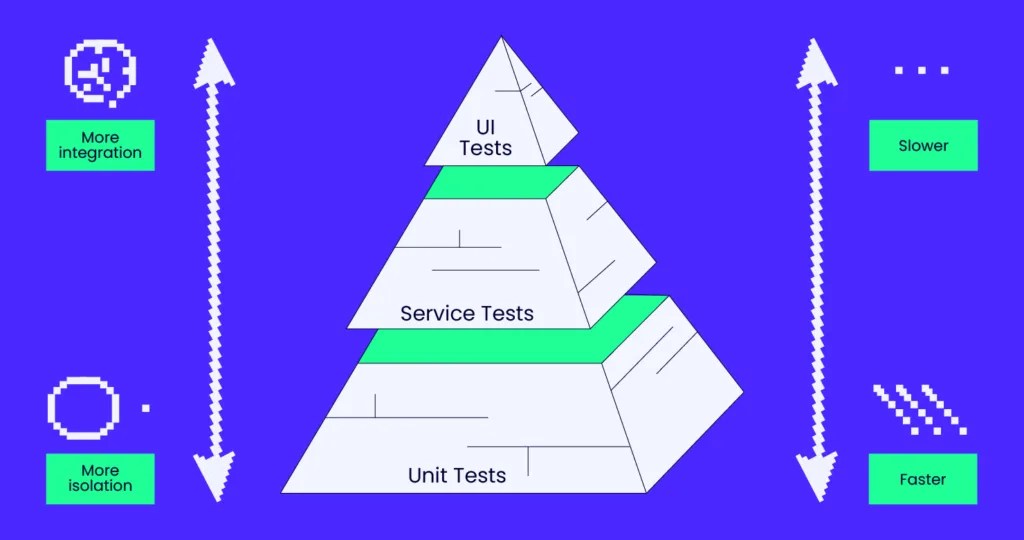
The Testing Pyramid offers us a strategic approach to balance these methods. Rooted in the philosophies found in discussions around the economics of unit testing, it promotes a heavy reliance on unit tests supported by a selective application of end-to-end tests. It’s a diversified approach to risk management, ensuring comprehensive coverage without disproportionate resource allocation.
The Bottom Line: Test Wisely
In the Swift development ecosystem, the art lies in knowing where to allocate your resources. Unit tests are your bread and butter, providing a steady and reliable feedback mechanism. End-to-end tests are the seal of approval, the final check before a product launch. Both are essential; neither is infallible.
Mastering the craft of developing fast, reliable, precise, and reproducible tests—be it unit or end-to-end—can significantly boost your ROI. It’s about making informed decisions that align with your business objectives and technical aspirations.
To be clear, the debate isn’t about which testing is superior—it’s about how each can be leveraged to deliver quality software within the economic realities of project budgets. As developers, our expertise is best utilized when we can articulate the business value of our technical choices, steering projects toward sustainable growth and prosperity.
“I’m a Developer, Not a Tester”: The Misconception in Modern Development
The dividing line between developer and tester roles is increasingly blurred. Whether we’re manually clicking through an app or writing sophisticated automated tests, developers are integral to the testing process. Manual testing, while foundational, can be a grind—labor-intensive and error-prone, it’s a practice that grows exponentially more cumbersome as the complexity of our systems scales.
Automation stands as a boost of efficiency in this context. It’s not just about productivity; it’s about the sustainability of our development pace and the quality of our work life. Developing a suite of tests that are quick, trustworthy, pinpoint accurate, and consistent in results elevates not just the project but also our professional standing.
Drawing the Economic Map: Testing as an Investment
To converse effectively with those who hold the purse strings, we need to speak in terms of investment and returns. It’s no different when discussing testing strategies.
The Developer’s Perspective: Maximizing Impact
Our craft extends beyond coding; it encompasses a strategic approach to testing. It’s about prudent resource allocation, ensuring the foundations are secure with unit tests while certifying the overall experience with end-to-end tests. Neither method is a panacea, but together, they form a symbiotic relationship that underpins successful software development.
Beyond Testing to Value Creation
The choice between testing methods is less about superiority and more about appropriateness within project budgets and goals. As developers, our role extends to articulating the business value of our technical choices, thereby steering our projects toward success and growth.
References
Unit Testing Principles, Practices, and Patterns: by Vladimir Khorikov
 App Academy
Leave a comment